
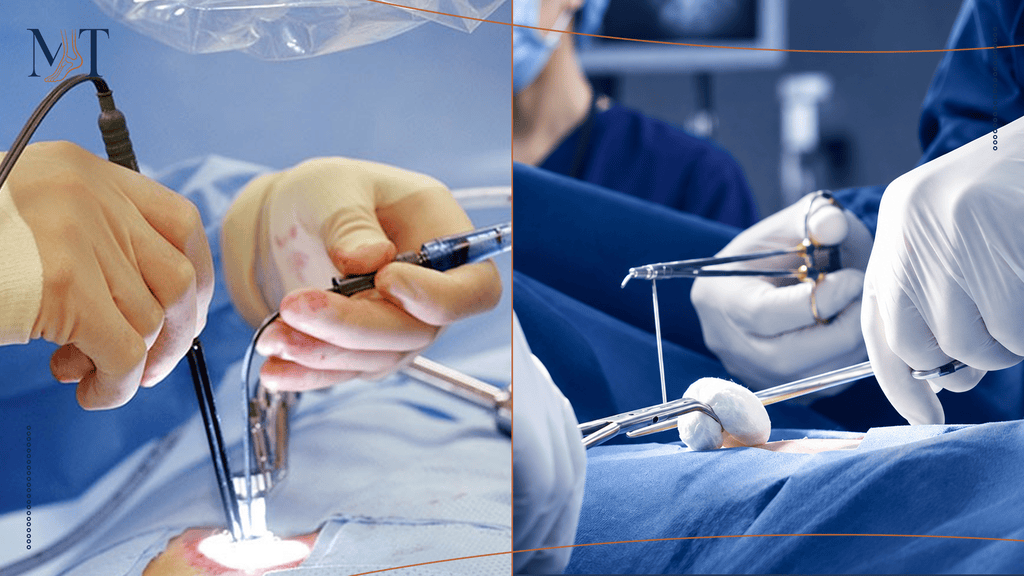
If you’ve been told you need bunion surgery, you’ve probably come across two terms: traditional (open) surgery and MIS (Minimally Invasive Surgery).
They aim for the same goal correcting the bone but how they get there is very different.
Traditional Surgery: The Older Approach
Traditional bunion surgery involves a single, longer incision along the side of the foot, giving the surgeon direct, open access to the bone. While effective, this approach means more soft tissue disruption, a longer healing period, and a more visible scar.
MIS: A More Modern Approach
Minimally Invasive Surgery uses several tiny incisions, often just a few millimeters each, instead of one large cut. Specialized micro-instruments are guided through these small openings, with continuous X-ray imaging providing real-time visibility throughout the procedure allowing for a highly precise correction without opening up the foot.
Comparing Traditional Surgery vs MIS
| Traditional Surgery | MIS | |
| Incision size | One long incision | Several tiny incisions |
| Bleeding | More | Minimal |
| Scarring | More visible | Barely noticeable |
| Recovery time | Longer | Faster |
| Soft tissue damage | More | Minimal |
For the majority of cases, MIS offers real advantages in comfort and recovery.
That said, the right technique always depends on the specific case the severity of the deformity and overall foot structure. A proper evaluation is the only way to determine which approach best serves you.