
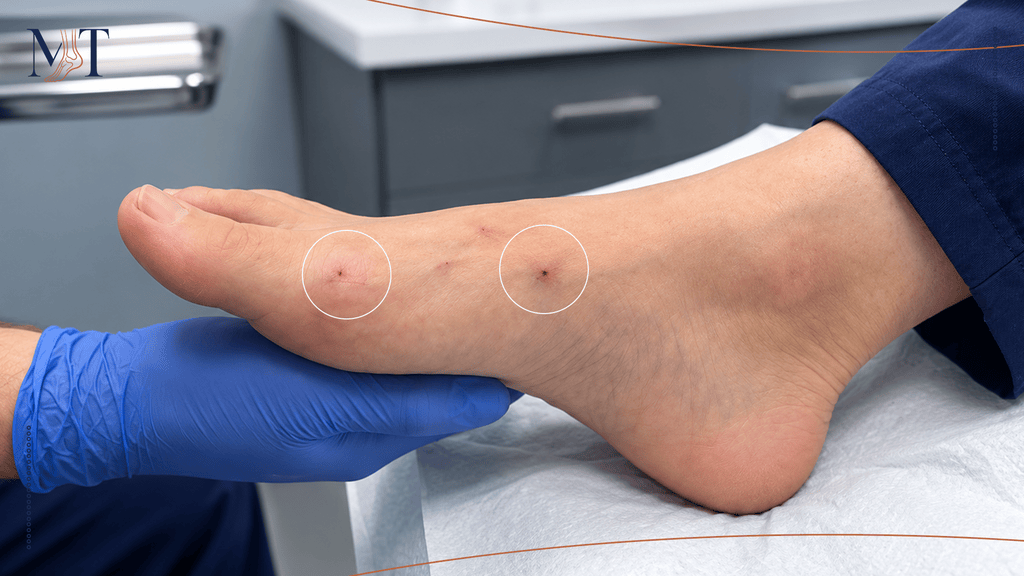
One of the most common questions patients ask before surgery is simply: “How big is the cut going to be?” And with MIS, the answer tends to be reassuring.
In MIS bunion correction, incisions are typically only a few millimeters long, often compared to the size of a small puncture rather than a traditional surgical cut. Instead of one long incision, the surgeon uses 2 to 4 of these tiny openings around the joint.
These small incisions are all that’s needed because the correction isn’t done by directly opening up and viewing the bone. Instead, specialized micro-instruments are guided through the tiny openings, while continuous X-ray imaging shows exactly what’s happening inside — allowing precise correction without a large opening.
What This Means for Recovery?
Smaller incisions typically mean:
- Less bleeding during the procedure
- Less soft tissue trauma
- A lower risk of infection
- Minimal, often barely visible scarring once healed
Will There Be Any Scarring at All?
Some minimal marking is normal with any incision, but because MIS incisions are so small, the resulting marks are usually far less noticeable than the longer scar left by traditional open surgery, a detail many patients particularly appreciate.