
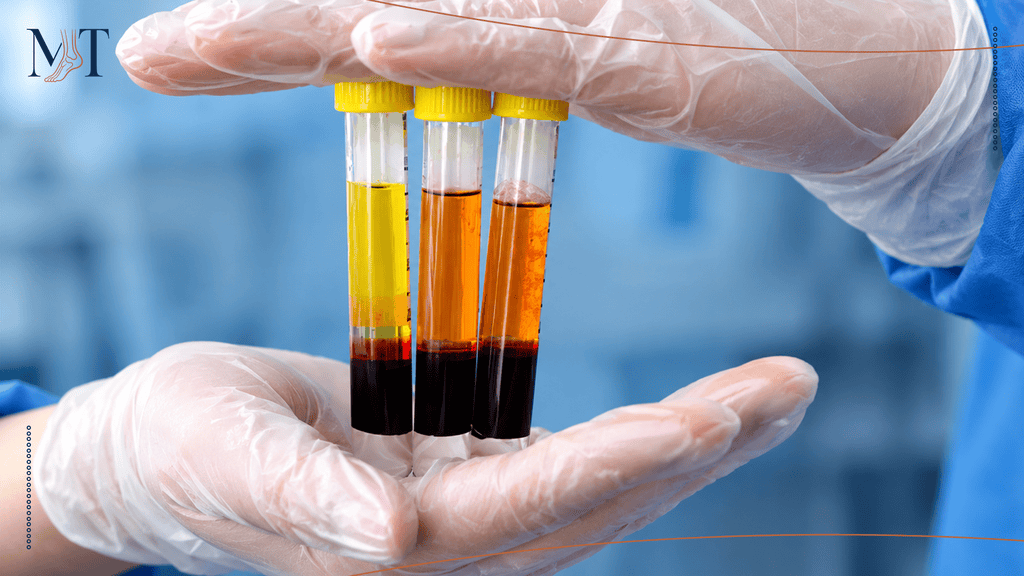
Not every foot and ankle issue requires surgery and that’s exactly where PRP (Platelet-Rich Plasma) therapy comes in as a valuable, less invasive option.
What Is PRP, Simply Put?
PRP therapy uses a concentrated portion of the patient’s own blood rich in platelets that naturally support healing and injects it directly into an injured joint or tendon.
The idea is to boost the body’s own repair process, right at the site that needs it most.
Where PRP Fits in Treatment?
PRP isn’t meant to replace surgery in every case. Instead, it plays a valuable role in:
- Chronic tendon injuries: Where healing has stalled and needs an extra push
- Early-stage joint issues: Before more advanced intervention becomes necessary
- Supporting surgical recovery: Used alongside surgery to potentially enhance and speed up the healing process
- Patients seeking non-surgical options first: As a starting point before considering more invasive treatment
Why It’s Gaining Popularity?
PRP is appealing because it uses the body’s own biological material, carries a low risk profile, and can often be done as a simple in-clinic procedure — without the downtime associated with surgery.
Is PRP Right for Everyone?
Not necessarily. The right candidate depends on the specific condition, its severity, and how it’s responded to other treatments so far. A proper evaluation helps determine whether PRP alone is enough, or whether it should be combined with another approach for the best outcome.
Regenerative medicine like PRP reflects a broader shift in orthopaedic care supporting the body’s natural healing ability whenever possible, and reserving surgery for when it’s truly the right next step